
Two Rabbi’s who said “(Gulp) …
... I guess that’s me!”
y …
A statement can be very wrong, and very right, at the same time.
For example, "Some are born great, some achieve greatness, and some have greatness thrust upon them."
Shakespeare, of course, in his Twelfth Night. It’s spoken by the pompous fool Malvolio, who is so full of himself, he’s easily duped into thinking his noble employer (Olivia) is madly in love with him.
What he said wasn’t wrong. It was just wrong when he applied it to himself.
Some people really do have greatness thrust upon them. (And usually tragedy and pain are linked with it.)
Case in point? Rabbi Moshe ben Maimon. Also known either as Maimonides, or the Rambam (RMBM - the acronym of his name).
Born 1135 CE in then-Muslim-ruled Spain, he flees for his life (and faith) when Jews are given a choice between death, conversion to Islam, or exile.
Not an ideal start. He winds up in Morocco, then Israel, then Eqypt.
But he’s maddeningly smart, and well schooled in Torah by his rabbi father. He’s also successful in business, as well-Torah-schooled Jews often are. It would be easy to be wildly jealous of him if he wasn’t also so likeable.
Then tragedy hits again. The family decides to concentrate their wealth in Moshe’s brother David, who goes on a big investment trip, but drowns at sea. Moshe loses savings and cherished brother in one fell swoop. Grief-stricken, he’s barely able to function for a year.
But he hasn’t stopped being maddeningly smart.
Unlike many of his rabbinical peers, he’s not afraid to learn from ancient Greek (e.g. Aristotle) and then-modern Islamic thinkers (this was the golden age of Islamic intellectualism).
He applies their thought principles to Torah and Talmud, and quickly pivots to becoming a physician. Successfully treats a number of common ailments (pneumonia, asthma, diabetes).
Not keeping his knowledge to himself, he publishes his learning and methods. Word gets around. Before long, he’s appointed physician to the Sultan’s secretary, then the Sultan himself.
When he finally leaves the palace every day, he’s besieged by the ill, Jew and Gentile alike, and he treats them all.
And somewhere in all this … he finds time to think, and write.
Prolifically. Works on law, philosophy, logic, medicine …
If you’ve ever studied law to any extent, you’ve probably heard this line: “Better a thousand guilty people acquitted than one innocent person convicted.”
That’s the Rambam.
And he gets frustrated trying to decide legal matters. The Talmud exists, but it’s not organised around specific problems. And it’s been over a millennium since the Mishna was penned.
He realises … somebody’s got to pull all this stuff together and make it accessible.
Who’s going to do that?
(Gulp) I guess that’s me. (Rabbi Steinsaltz would have recognised that feeling.)
Which is why today we have the Mishneh Torah. One Jew’s attempt to pull together all the previous works …
… (and by all, I mean all of halakha, not only the laws that apply today, but also Temple service, kingship, purity, sacrifices, agriculture, courts, Shabbat, prayer, ethics, repentance, Torah study, forbidden foods, marriage, and society) …
… and make it easy for the average then-everyday Jew to make decisions.
Now fast forward eight centuries, and those then-everyday Jews are long gone (as is the language they used).
We’ve got 21st-Century-everyday Jews now, with 21st Century problems, experiences, habits, etc.
Who’s going to pull the Rambam’s stuff together for them?
Gulp. I guess that’s me, thought Rabbi Steinsaltz.
And it’s all done now, as Rabbi Steinsaltz’ grandson explains in this video. The Rambam translated into modern English, with the Rav’s commentary on it.
And it’s all in the Steinsaltz Daily Study App, downloadable for free.
- Rabbi Meni Even-Israel
P.S. Already downloaded the Steinsaltz Daily Study App? And would like to stop receiving emails about it? Click here.
(The App page will reopen, but take no action. Your address will automatically be added to our list of our app users, and you'll stop receiving emails about it.
Steinsaltz Center | P.O. Box 7273 | Jerusalem, 91071 IL


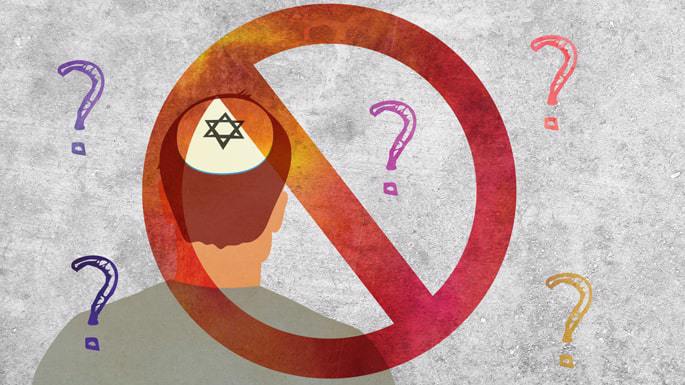
In the 1930s, a Nazi confronted a Jew: “You Jews are the cause of all the world’s problems!”
“Yes,” says the Jew. “You’re right. And the bicycle riders.”
“The bicycle riders? Why the bicycle riders?” asked the Nazi.
“Why the Jews?!” responded the Jew.
Is Antisemitism logical? Of course not.
Over the centuries, numerous “reasons” have been advanced to explain the phenomenon of Antisemitism.
We “killed” their god, poisoned their wells, killed their children to use their blood for our Pesach wine or matzahs … the list of preposterous accusations goes on and on.
Are any of those fictitious so-called reasons really reasons? No. We know they were all just excuses.
A generation ago it was “Jews, get out of Europe. Go back to Palestine!”
Today, it’s “Jews, get out of Palestine. Go back to Europe!”
Less than 80 years since the Holocaust, Antisemitism has become almost acceptable around the world.
So is there actually a “reason” for Antisemitism?
Rabbi Menachem Ziemba was one of the leading rabbis in pre-war Poland. He died in the Warsaw Ghetto, where he refused to abandon his flock. But some of his writings survived.
Let me share with you one of his Torah teachings, because it goes to the very core of the question of Antisemitism and whether there is, in fact, any reason for it.
This week’s Torah reading tells the dramatic tale of two long-lost brothers, Jacob and Esau, who are about to meet after 20 years of separation. Esau is still gunning for his twin brother, who he claims stole his birthright and his father’s blessings. He has murder on his mind.
Jacob prepares with a three-pronged approach:
- Diplomacy. He sends Esau a huge gift to pacify him.
- Military strategy. He prepares to battle if diplomacy fails.
- He prays to G‑d for deliverance.
In the end, Esau sees his brother’s generous gift (entire herds of livestock), and he sees his family, and seems mollified and ready to make peace. Instead of killing Jacob, he embraces him, and they have an emotional reunion:
And Esau ran towards his brother, and he embraced him. He fell on Jacob’s neck, and he kissed him, and they wept.1
Now, in the Torah scroll, there are dots written above the Hebrew word vayishakeihu, “and he kissed him,” indicating that not all is as it appears to be. It is like an asterisk—a footnote is required to explain and qualify what is really meant.
Rashi offers two explanations:
- “He didn’t really kiss him with all his heart.” It was more like a photo op. Like politicians running for election and kissing babies in the streets.
- Rabbi Shimon ben Yochai says, “It is an established law (halacha) that Esau hates Jacob. But at that moment he was moved to mercy, and he did in fact embrace him with a full heart.”
Let’s take a closer look at the language Rabbi Shimon uses. “It is a halacha that Esau hates Jacob.” Why the word halacha? A rule or a principle, perhaps. But a law? Surely it seems out of place here!
This is what Rabbi Menachem Ziemba, powerful scholar and a holy martyr of the Warsaw Ghetto, had to say:
People don’t always agree with or understand a halacha, a law. Do you understand and agree with every legal judgment handed down by the court? Of course not. But a law is a law and a fact of life. There’s simply nothing we can do about it.
Likewise, says Rabbi Ziemba, is the halacha of Esau hating Jacob. Antisemitism is a halacha, a law, a fact of life! We don’t understand it. It makes no sense.
Jews are nice people. We do so much for society, beyond our own communities. We are constantly contributing to the world around us, and the world still doesn’t like us. It hurts. But it is what it is.
And to show just how illogical it is, he went on to say from his own personal experience: “In Poland they hate the Jews because they are poor. Scum of the earth. In Germany they hate the Jews because they are rich, taking their money. In Russia they hate the Jews because they are bourgeois Capitalists. And in America they hate the Jews because they are Communists!”
In other words, we can’t win.
In our times, the Antisemites say there was no Holocaust. And the very same people say Hitler didn’t finish the job, he didn’t kill enough Jews!
Is this rational? Logical? Does it make any sense at all? No! Because Antisemitism is an immutable fact of life, just like a halacha. We don’t get it, but it is what it is.
And because there is no logical reason, there is no logical solution either.
So, my friends, I’m sorry to tell you that despite the best efforts of the ADL, or the Simon Weisenthal Center, or the State Department’s Envoy on Antisemitism, Antisemitism is not going away.
But don’t become disillusioned, and don’t become depressed when you see Antisemitism is still here and growing at an alarming rate all over the world.
Because while there may not be any logical reason for Antisemitism, there certainly is a response. And what response should that be? To continue to live as proud, practicing Jews, here on a mission to bring positive change to the world. To be confident and knowledgeable Jews, who live as Jews and raise our children and grandchildren as Jews. As the late Rabbi Lord Jonathan Sacks kept reminding us: “Non-Jews respect Jews who respect Judaism!”
And certainly, we should all learn from the Rebbe, whose approach David Suissa describes as “Pro-Semitism.” Be pro-Jewish and proactively Jewish. Do a mitzvah today that you may not have done yesterday. And if you need further motivation to do it, let Antisemitism be your motivation. Do it davka! To spite the Antisemites.
Jewish pride, Jewish defiance, Jewish continuity, will lead to nothing less than Jewish eternity.
